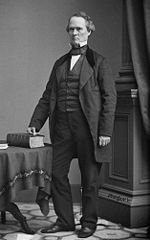
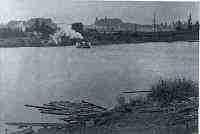
 Salem Ferry 1885-1886 Less than five years after the establishment of Salem’s Oregon Institute, James White settled on his Polk County land claim. “directly opposite” the school that would become Willamette University. He early saw the need for a transportation link across the river and, with two grown sons from his first marriage, White had a ready-made crew to operate that first primitive rope ferry.
Forming a partnership with W. H. Willson in Salem and lodging his son Bartholemew with merchant James Holman in the city to handle business on the east side of the Willamette, “Capt’ White” inaugurated ferry service in 1846.
As earlier Marion County ferries were already operating on the river, the Provisional Government passed an act regulating ferry service, the license for which cost only $2 per year. It wasn’t until four years later, though, that ferry usage rates were established; up until that time, the service was largely “on call” with no fixed schedule, and the rates charged were entirely at the discretion of the owner. In September of 1849 the Probate Court fixed the rates and stipulated that this fee schedule be posted prominently at each ferry landing:
| Wagons and yoke of Oxen or span of Horses |
$1.00 |
| Each additional yoke or span |
$0.25 |
| Each man and horse |
$0.25 |
| Do. footman |
$0.12 & 1/2 |
| Do. head of neat Cattle |
$0.08 |
| Each head of Sheep, Goats, or Hogs |
$0.06 & 1/2 |
| Each 100 ft. of lumber not on wagons |
$0.12 & 1/2 |
| Do. 100 weight not on wagons |
$0.12 & 1/2 |
| Do. horse and Carriage |
$0.75 |
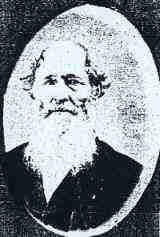 James White “Fifty percent to be added during the winter months.” This latter stipulation was a form of insurance for the owner-operator as often high water made the crossing hazardous.
Willson refused to accept this rate schedule until the fees were doubled, but only 25 percent was added during December, January and February. Besides the danger of high water, there were other difficulties the ferryman faced: the main rope on occasion would break; loads on the ferry would shift and dump horses, wagons and passengers into the river; floating debris collided with the boats; sometimes the vessels became detached from their cables and were cast adrift. In addition, frequent criticisms were voiced in the local press on the quality of the service. Despite all these difficulties, each year when licensing time rolled around, James White or one of his sons appeared before the County Commissioners Court to renew the Salem ferry license.
In 1854 this changed: Capt’ White died in the explosion of the steamer Gazelle at Canemah on April 8, 1854. Ferry operations devolved upon his sons and his wife Rhoda. Following her husband’s death, the widow moved to Salem and actively ran the ferry. Two short-lived marriages for the widow, to Vermonter Horace Rice in October of 1855 and to Joseph H. Heness in August of 1859, ended in divorce.
 Woman believed to be Rhonda White Following her divorce from Heness in January of 1860, Rhoda White was again sole proprietor of Salem’s ferry service as her stepsons had now gone into riverboat service. When she renewed her two-year license in 1861, it was just before the devastating floods in December that swept away thousands of dollars’ worth of valuable property in the Valley. The ferry itself sank and its load of wheat drifted downstream.
For nearly a decade Rhoda kept Salem’s ferry in business (with help from her stepsons and her two “brief” husbands) but in 1863 she took on a partner. Jasper N. Matheny was from a family associated with ferry operations for nearly two decades. Together they invested in a new steam ferry and were successful in acquiring an increase in rates for the river crossing.
By the following year, Rhoda had sold her Salem property and all interests in the ferry operation to Matheny and his new partner, Lewis Johnson. That partnership dissolved early in 1866 when John Barger of Silverton teamed with Johnson to apply for the ferry license in 1866 and ’67. Matheny returned to ferrying in 1867 with a group of investors: James N. Glover (later the “Father of Spokane, Washington”) and a father and son-in-law team, Elijah and Richard Williams (later replaced by J. W. Smith). Their participation allowed the purchase of an additional ferryboat to run between east and west shores of the Willamette.
By December of 1872 Matheny, Glover and Smith had sold out to A. H. Whitley of Polk County, but his legal problems forced a transfer to Matheny in April of 1874, then to the Salem Ferry Company in July of that year.
Incorporated in June, the Salem Ferry Company was capitalized with 210 shares at $100 divided between three principals: Matheny, Reuben P. Boise Sr. and P. L. Willis. Actual ferry operations were turned over to A. W. Hewitt with an assist from another generation of Mathenys–David L.
A truly long-awaited improvement in creature comfort on the river crossing was accomplished just prior to this incorporation: an above-deck cabin to keep passengers protected from the elements. Ferry tolls at this stage had been reduced as well:
| Wagon and span of animals |
$0.33 & 1/2 |
| Additional animal |
$0.10 |
| Man and horse |
$0.25 |
| Footman |
$0.12 & 1/2 |
| Loose animal |
$0.10 |
| Hog, sheep or Goat |
$0.05 |
| 100 lb. freight not on wagon |
$0.10 |
| 100 ft. of lumber not on wagon |
$0.10 |
| pack animal with load |
$0.15 |
A new steel bridge across the Willamette opened December 2, 1886; a local reporter eulogized the now superseded ferry with these words:
“Ferryboat rest! Thy work is done;
Sleep the sleep that knows no breaking,
Dream of ferrying men no more;
Through days of rain, and nights of waking.”
The reporter’s obituary was a trifle premature, however, as just four years later the bridge structure washed eight miles north in the flood of 1890. Tom Holman was asked to reinstate ferry service until the bridge could be replaced. The bridge project was completed in 1891, but even after that the Salem Ferry Company was still operational. Later, during repair work to the bridge approaches in 1902, the ferry serviced east- and westbound travelers.
Finally, in late 1905 the Secretary of State declared the ferry company defunct and ordered it dissolved. For six decades the ferry had been a vital link in the development of Salem and Polk County.
Researched and written by Sue Bell.
Bibliography:
Custer, Jean and Daraleen Wade. “Marion County Oregon Marriage Records 1849-1871.” Salem: Willamette Valley Genealogical Society, 1979.
Daily Oregon Statesman, 3 Mar. 1874, 1 Dec. 1886.
Judson, Lewis H. Reflections on the Jason Lee Mission and the Opening of Civilization in Oregon Country. Salem: Wynkoop-Blair Printing Service, 1971.
Marion County Commissioners Court Journals, Vols. I, III-V, Oregon Archives, Salem.
Marion County Miscellaneous Records, Vol. I, pp. 20,21.
Oregon Argus, 23 Sept. 1856.
Oregon Department of Commerce/Corporate Division, Item #4713, Oregon Archives, Salem.
Oregon Statesman, 9 Dec. 1861, 21 Aug. 1863, 12 Mar. & 7 May 1890, 10 Aug. 1902.
Oregon Territorial Census, 1850.
Oregonian, 9 April 1854.
Salem Daily Record, 26 Aug. 1867.
State of Oregon Government and Territorial Documents–Act #1165 & 3679, Oregon Archives, Salem.
State of Oregon Government and Territorial Documents–#9413, Oregon Archives, Salem.
Oregon Department of Commerce/Corporate Division, Item #4713, Oregon Archives, Salem. |