Following is the transcript of the keynote address given by Mathew Deady at the Third Annual Reunion of the Oregon Pioneer Association on June 15, 1875. The Oregon Pioneer Association was an organization of those who emigrated to the Oregon Country. Jasper Hewitt was the president at the time of his death. The association was later dissolved when those who had come across the plains had all passed. The subsequent organization is Sons and Daughters of Oregon Pioneers and is still very active.
In speaking to the very individuals who crossed the Plains, Mr. Deady describes the Euro-American settlement of the region and how it came to be part of the United States of America, starting with the explorers, but not referencing the people who were already here.
This historical document is included on the website unedited because, besides the information it contains, it also provides context and perspectives of the time in which the people and events took place. As a family association, we do not necessarily agree with all of the perspectives that are presented here and we also recognize that there may be many other perspectives besides that of the presenters.
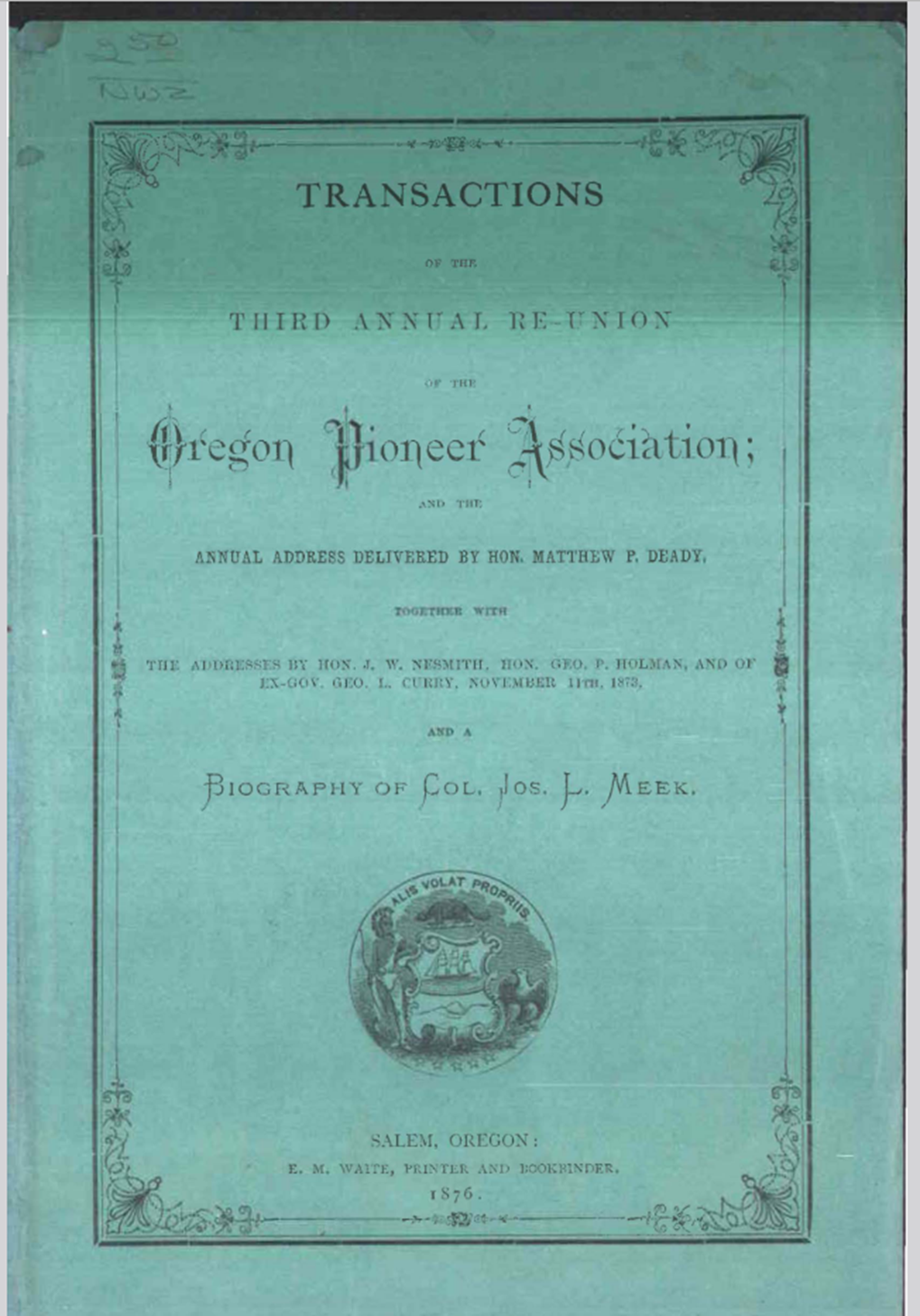
THE ANNUAL ADDRESS.
BY THE HON. MATTHEW P. DEADY.
Hon. Matthew P. Deady, of Portland, was then introduced by
the President, and in a full voice, with his usual forcible manner,
delivered the following address:
OREGON PIONEERS, LADIES AND GENTLEMEN:
Allow me to congratulate you upon being permitted to assemble here under
the sheen of the Stars and Stripes, on this Twenty-Ninth Anniversary of the
final acknowledgment of Great Britain of the American right to the Oregon territory.
Having wisely resolved to meet together annually and celebrate your
entry into the country, and brighten and perpetuate the memory of your early
trials and sufferings while engaged in making the weary journey from the Missouri
to the Wallamet, and transplanting, to this then far off shore, the customs,
laws and institutions of Alfred and Washington, you could not have selected a
more appropriate day for the occasion, than this. Just twenty-nine years ago, your
only rival and competitor for the possession of this goodly land, by the treaty of
Washington, in effect admitted, that the OREGON PIONEER, unaided by his
Government, and despite the deeply interested opposition of the far-reaching
Hudson Bay Company, backed by the power and diplomacy of the English
Crown, although bringing with him across the trackless wilds of the continent
little else than the Family, the School and the Church, had succeeded in occupying
the country and rearing therein, upon these institutions, as foundation
stones, the enduring edifice of an American State.
But we are not here to triumph over those who failed in the struggle for the
prize or cast reproach upon their policy or conduct. The object of the Hudson
Bay Company in occupying the country, was to secure the exclusive trade with
the Indians and such British subjects as might suit its policy to allow therein,
and it pursued this object as justly and considerately as could be expected. Its
autocratic government and discipline was such as best suited its condition and
pursuits. It did not seek to build towns, establish political communities, or
even to cultivate the soil, except in very limited measure. Its factors, traders
and clerks; though generally just and intelligent men, were a part of an unyield
ing system which compelled them to live for, and promote the special interests
of the Company before those of the country.
But justice demands that I should name, at least, one notable exception to
this general rule.
Dr. John McLoughlin was Chief Factor of the Company, west of the Rocky
mountains, from 1823 to 1845, when he resigned the position and settled at Oregon
City, where he died in 1857, full of years and honor. During this period
he was the controlling power in the country, and did more than any one else to
preserve order, peace and good will among the conflicting and sometimes lawless
elements of the population. Although, as an officer of the Company, his
duty and interest required that he should prefer it to the American immigrant
or missionary, yet at the call of humanity, he always forgot all special interests,
and was ever ready to help and succor the needy and unfortunate of whatever
creed or clime.
Had he but turned his back upon the early missionary or settler and left them
to shift for themselves, the occupation of the country by Americans would have
been seriously retarded, and attended with much greater hardship and suffering
than it was. As has been truly and eloquently said of him by another “He
was a great man upon whom God had stamped a grandeur of character which
few men possess, and a nobility which the patent of no earthly sovereign can
confer. His standard of commercial integrity would compare with that of the
best of men. As a Christian, he was a devout Roman Catholic, yet nevertheless
Catholic in the largest sense of that word.”
For at least a quarter of a century McLoughlin was a grand and potent figure
in the affairs of the Pacific slope. Compared with his surroundings and meas
ured by his opportunities, in majesty of appearance and nobility of soul, he
was —
“As some tall cliff that lifts its awful form,
Swells from the vale, and midway leaves the storm,
Though round its breast the rolling clouds are spread,
Eternal sunshine settles on its head.”
But he has long since gone to his rest. Peace to his ashes! Yet good
deeds done in the body are a lasting monument to his memory, and shall in due
time cause his name to be written in letters of gold in Oregon history. As I pass along where he fell out of the ranks of life, I reverently turn aside and drop this
stone upon his neglected CAIRN, and hope every OREGON PIONEER will say, Amen.
Page upon page has been written to prove that Oregon belonged to the United
States by right of discovery, and by virtue of the French cession of the territory
of Louisiana of April 30, 1803, and the treaty of limits with Spain, of February
22, 1829, by which the latter relinquished her rights to the country north and
east of a line therein described and agreed upon.
But these indefinite grounds of title, although as good as any set up against
them, were the mere makeweights of diplomatic controversy and finesse, and
had but little, if any effect, upon the final result. The accidental discovery in 1792, of the mouth of the Oregon by a private adventurer in the ship Columbia,
who never attempted to make any use of the fact or exploration of the country,
was a very insignificant and insufficient circumstance upon which, after a lapse
of fifty years, to base a claim to a country crossed by seven degrees of latitude
and nearly as many as many more of longitude. The fact of the entry and exploration
of the river, for the distance of one hundred miles from its mouth, at
a latter period of the same year, by the British navigator, Vancouver, is of the
same general character. In the absence of any other claim to the country, either
circumstance might be relied upon by the Governments of the respective discoverers,
as giving them some right to the possession of the territory drained by
the river. But upon these facts alone, as between Great Britain and the United
States, I think the better right was with the former; for, as I have said, Gray
was only a private citizen engaged in a mere mercantile adventure, and made
no exploration of the river above its mouth, while Vancouver was a commissioned
officer of the British Government engaged in exploring the coast, who
entered the river and explored it as far east as the present town of Vancouver.
But as against a title derived from the actual occupation of the soil by any considerable
number of the people of either nation, a claim based upon such inconclusive
circumstances, ought not to weigh a feather.
The only direct result of Gray’s discovery, has been the change of the name
of the River of the West from the OREGON to the COLUMBIA, in compliment to
his ship. For many reasons the change is to be regretted, but I suppose it is
now beyond recall. Yet the sonorous original is embalmed in the beautiful
lines of Bryant, and will not be forgotten while Thanatopsis remains to edify
and delight the world:
“Take the wings
Of morning– and the Barcan desert pierce,
Or lose thyself in the continuous woods,
Where rolls the OREGON, and hears no sound,
Save his own dashings–yet–the dead are there.”
From the beginning, the right to the country was to depend upon the successful
occupation of it, The race for possession was between Great Britain and ..
the United States –the former represented by its Fur Companies with their hierarchy
of educated and trained officers and clerks, and motley following of
Canadians, half breeds and Indian–the latter by the Eastern trader and Missionary
and particularly the Western woodsman and farmer. Primarily, the
English sought to occupy the country for the purpose of carrying on the fur trade
with the Indians. It was to be keept from the plough and the sickle and preserved
as a breeding ground for fur bearing animals except so far as the limited
necessities or convenience of the Company might otherwise require. Many of
the “gentlemen” of the Company regarded the country as a mere outpost, in
which they were engaged in a temporary service.
On the other hand, the American settler was always animated–often it may
have been unconsciously–with the heroic thought that he was permanently en.
gaged in reclaiming the wilderness–building a home–founding an American
State and extending the area of liberty. He had visions, however dimly seen,
that he was here to do for this country what his ancestors had done for savage
England centuries before–to plant a community which in due time should grow
and ripen into one of the great sisterhood of Anglo-American States, wherein
the language of the Bible, Shakespeare and Milton should be spoken by millions
then unborn, and the law of Magna Charta and Westminster Hall be the bulwark of liberty and the buttress of order for generations to come.
Under these circumstances, it is not to be wondered at, that this British army
of occupation failed to take deep root in the soil and hold the country as against
the OREGON PIONEER. But at one time, apparently, the odds were largely in its favor.
Only forty-five years ago, a casual observer might have concluded that
the arch of the American Union would never span this continent. So late as that
period, the territory did not contain an American citizen. Practically, it was under
the control and in the occupation of the subjects of Great Britain and their Indian
allies and dependents. But to-day not a vestige of the once undisputed dominion
of the great British corporation remains to be seen, while the Stars and Stripes
float free from every battlement and mast-head from the mountains to the sea.
Before proceeding to speak of the great emigrations from the West to Oregon,
between the years 1840 and 1846, which by their numbers and character finally
determined the question of occupancy, let us glance at the progress of discovery
and settlement up to that period.
Between 1804 and 1806, the expedition of Lewis and Clarke traversed the
Continent from the mouth of the Missouri to that of the Columbia, and returned
to the place of starting. It wintered in the country on the south side of the
river, near its mouth. This expedition was authorized and supported by the
National Government, and is more properly entitled to the credit of discovering
the river than either Gray or Vancouver. Altogether, it did much to attract the
attention of the people of the United States to the country, and impress them
with the feasibility of manking the journey to the Pacific shore by land.
The entrance of the Tonquin into the Columbia in, 1811, and the establishment
of a trading post at the mouth of the river by Astor’s Fur Company, together
with the overland journeys of Hunt, Stuart, Franchere, and others of the
Pacific and Northwest companies, prior to the year 1815 also served to familiarize
the inhabitants of the United States with the general character of the
country and its proximity and relation to the acknowledged American territory.
The war with Great Britain having caused the failure of Astor’s project to occupy
the country with a psuedo American fur company, the property and trade of the
Pacific Fur Company fell into the hands of the Northwest Company–a British-
Canadian organization.-some of whose members constituted the principal persons
in Astor’s company. Thereupon Astoria became Fort George, and the
Northwest Company was the dominant power in the country until 1823, when it
was merged into the Hudson Bay Company; thenceforth the latter ruled in
Oregon, until it was superceded by the government of the PIONEERS. With the
advent of the Hudson Bay Company, the seat of empire was removed from Fort
George to Vancouver, which latter place became the western emporium of this
great colonial corporation. There for full twenty years, its Chief Factor, Mc-
Loughlin, held baronial sway governing the country with a strong hand but a
just judgment, and dispensing a primitive but generous hospitality to the weary
traveller or chance tourist of whatever race or land. The scream of the American
eagle was unheard in the country while the British lion roamed without a
rival from Fort Hall to Fort George and from Colville to Umpqua.
And now diplomacy entered the arena and conceded that, notwithstanding
the partial discoveries of Heceta, Mears, Gray, Vancouver, Lewis and Clarke,
the country was open to be occupied by the people of either nation.
On October 20, 1818, it was agreed by the third article of the treaty of London,
” that any country that may be claimed by either” Great Britain or the
United States “on the Northwest coast of America, westward of the Stony
mountains” * * * should be free and open for the term of ten years
to the vessels, citizens and subjects of the two powers.” By this act the two
high contracting parties virtually admitted to the world, that neither of them
had any perfect or acknowledged right to any country westward of the Stony
mountains, or that at most, they had but a claim of right to some undefined part
of that comparatively unknown region. This convention, apparently acting
upon the admission that neither party had any definite right to the country, and
that like any other unsettled and unowned portion of the globe, it was open to occupation by the first comer, expressly recognized the right of the people of
both nations to occupy it for the time being, at pleasure.
Thus was sanctioned that occupation of the country by Great Britain, which
was practically commenced some years before, with the transfer of the property
and business of the Pacific Fur Company to the Northwest. This convenient
condition of things was continued indefinitely by the treaty of London, of August
i6, 1827, with liberty to either party “to annul and abrogate” it at any
time after October 20, 1828, by giving notice of such purpose.
And now commenced a movement that, if it had been successful, would have
hastened the occupation of the country and the acknowledgment of the Ameri
can title to it by at least ten years. As early as the year 1817, Hall J. Kelley,
of Boston, began to advocate the immediate occupation of the Oregon territory
by American settlers. He became an enthusiast upon the subject, and spent
his time and some fortune in promoting a scheme for emigration to the country
As early as 1829 he procured the incorporation, by the commonwealth of Mas
sachusetts, of “The American Society for the settlement of the Oregon territory.”
From a memorial presented by the society to Congress, in1831, it appears
that it was “engaged in the work of opening to a civilized and virtuous population
that part of Western America called Oregon.” The memorialists state that
“They are convinced that if the country should be settled under the auspices of’
the United States of America, from such of her worthy sons who have drunk the
spirit of those civil and religious institutions which constitute the living fountain
and the very perennial source of her national prosperity, great benefits must result
to mankind. They believe that there the skillful and persevering hand of
industry might be employed with unparalleled advantage; that there science and
the arts, the invaluable privilege of a free and liberal government, and the re-
finement and ordinances of Christianity, diffusing each its blessing, would harmoniously
unite in meliorating the moral condition of the Indians, in promoting
the comfort and happiness of the settlers, and in augmenting the wealth and
power of the Republic.”
After stating “that the country in question is the most valuable of all the unoccupied
portions of the earth,” and designed by Providence “to be the residence
of a people whose singular advantages will give them unexampled power
and prosperity,” the memorial adds “That these things ‘ * * * * *
have settled in the policy of the British nation the determined purpose of possess
ing and enjoying the country as their own, and have induced their Parliament to
confer on the Hudson Bay Company chartered privileges for occupying with
their settlements the fertile banks of the Columbia. * * * * * Already have they flourishing towns, strong fortifications and cultivated farms * * * Their largest town is Vancouver, which is situated on a beautiful plain, in the region of tide water, on the northern bank of the Columbia. * * * Everything, either in the organization of the government,
or in the busy and various operations of the settlements of this place, at
Wallawalla, at Fort Colville and at De Fuca, indicate the intention of the English
to colonize the country. Now, therefore, your memorialists, in behalf of a
large number of the citizens of the United States, would respectfully ask Congress
to aid them in carrying into operation the great purposes of their institution–to
grant them troops, artillery, military arms and munitions of war for the security of the contemplated settlement — to incorporate their society with power to extinguish the Indian title to such tracts and extent of territory, at the mouth of the Columbia and the junction of the Multnomah with the Columbia, as may be adequate to the laudable objects and pursuits of the settlers; and with such other powers, rights and immunities as may be at least, equal and concurrent to those given by Parliament to the Hudson Bay Company; and such as are not repugnant to the stipulations of the Convention, made between Great Britain and
the United States, wherein it was agreed that any country on the Northwest
coast of America, to the westward of the Rocky mountains should be free and
open to the citizens and subjects of the two powers, for a term of years; and to
grant them such other rights and privileges as may contribute to the means of
establishing a respectable and prosperous community.”
Mr. Kelley was the general agent of the Society. In 1831 he published a
pamphlet, entitled “A general circular to all persons of good character, who
wish to emigrate to the Oregon Territory,” which set forth the general objects
of the Society. The opening paragraph discloses the fact that the subsequent
cry of “Fifty-Four-Forty-or-Fight” had not then been invented nor the claim
upon which it was based known or understood. It commences–” Oregon Settlement.
To be commenced in the spring of 1832 on the delightful and fertile
banks of the Columbia river. It has been for many years in serious contemplation
to settle with a free and enlightened but redundant population from the
American Republic that portion of her territory, called Oregon, bounding on
the Pacific ocean and lying between the forty-second and forty-ninth parallels of N. latitude.”
As appears, the banks of the Columbia were then supposed to be the valuable
portion of the country, while the great WalIamet valley where “the clouds drop
fatness” and seed-time and harvest never fail, was scarcely known or mentioned.
The names of 37 agents of the Society are given in the pamphlet, from any of
whom, persons desirous of becoming emigrants to Oregon under its auspice might obtain
the proper certificate for that purpose. The agents were scattered over the
Union. Only two of them–Nathaniel Wyeth, of Cambridge, Mass.
and Mr. Kelley himself–ever visited the scene of the proposed colony.
The expedition was to start from St. Louis in March, 1832, with a good supply
of waggons and stock. Each emigrant was to receive a town and farm lot
at the junction of the Columbia and Multnomah rivers, and at the mouth of the
former, where seaports and river towns were already laid off–on paper.
But this scheme bore no immediate fruit. Congress was busy with some po-
litical abstraction and could not spare the time or stoop to give attention to a
plan for founding an empire on the Columbia; and so the American occupation
of the disputed territory was delayed for at least another decade. Nevertheless,
the agitation of the project brought the country favorably before the public, and
here and there set certain special forces and interests in motion, which in due
time materially aided the consummation, Hall J. Kelley so devoutly wished,
and so long labored for.
To him, more than any other one person, in my judgment, may be justly attributed
the subsequent occupation of the country by emigrants from the United
States–and Oregon should in some way worthy of the subject and herself yet
acknowledge and commemorate that fact.
In the year 1832, Nathaniel Wyeth, crossed the plains to Oregon, and returning
by the same route to Boston in 1833, came back in 1834 arid established
himself as an independent trader in the country; having sent his goods around
the Horn the same year in the May Dacre. He established his headquarters
on Wappatoo island, near the mouth of the Wallamet. A continuation of ill luck,
including a dearth of salmon in the Columbia river for two successive
years, induced him, after an experiment of three years, to abandon the enter
price. He disposed of his property to the Hudson Bay Company, who placed a
Frenchman by the name of Sauve on the island, as a dairyman. In after years
when the western emigrants found their way to this country, they called it from
this fact, Sauve’s island and thus the original name by which it was known
and settled by Wyeth, was lost.
Yet this attempt of Wyeth’s, which itself was largely a consequence of Kel
ley’s scheme, was not without results conductive to American occupation.’
Divers persons employed in the enterprise remained in the country and were the
beginning of the independent American settlers in the country.
Among them were the well known names of O’Neil, Hubbard, and Smith. Afterwards, these men exerted a positive influence in favor of American interests and the formation of the Provisional government. The last named–the Hon. Solomon Smit–is still living and at present a member of the Senate from Clatsop county. He came here from New Hampshire in 1834, and has been a useful and exemplary citizen of the country ever since. I believe he is the oldest Pioneer now living.
Besides these, there came with Wyeth, Nuttall the naturalist, and Townsend the ornithologist, whose accounts of their explorations and observations did much to attract the attention of the scientific and curious to the country.
To this expedition we also owe in great part the presence of the first Methodist missionaries in the country–the Lees, Shepard and Edwards, who crossed the plains with Wyeth in 1834; their goods. being shipped by him with his own in the May Dacre. This was the beginning of the Methodist mission in Oregon.
The other members of the mission–among who were Willson, Beers, Leslie, Waller, Hines, Judson, Parrish, Abernethy, Campbell and Babcock–came to the country between this year and 1840–many of them in the latter year. They were mostly from the Eastern States. Their professed object in coming to the country was a religious one–to convert the Indian to the Christian religion– rather than to occupy the country and establish therein an American community and State. They came simply as missionaries to the Indians, and as such were made welcome by the Company. Incidentally, of course, they expected to occupy mission stations, and engage in such secular labor as might be necessary and convenient for the maintenance of their work among the Indians. When they landed in the country they did not burn their ships.
It was expected that their base of operations would be in the east; and after a few years spent in ministering to the heathen, the missionary himself might return to his friends and home in the land from whence he came. Their Board of Missions had very little idea of the character and value of the country or of the important and far reaching results which were to issue from their futile mission to the Indians of Oregon. So late, even, as 1844, their organ, the New York Christian Advocate, published an article on Oregon which was quoted in Congress during the debate on the resolution to terminate the treaty of joint occupation, to show that the country was not worth quarreling about. The article contained the following paragraph: “We have some opportunity from our position, to found a correct estimate of the soil, climate, productions and facilities of the country from the Rocky Mountains to the Pacific ocean, as we have had a large mission there for several years, distributed in small parties over the territory; and from all that we have learned we should prefer migrating to Botany bay. With the exception of the lands of the Wallamet, and strips along a few of the smaller water courses, the whole country is among the most irreclaimable, barren wastes of which we have read, except the desert of Sahara. “
But now after the lapse of years, we can readily see how these simple men
were really the unconscious instruments in the hands Of HIM who “hath made
the round world” and ruleth the destiny of all nations that dwell thereon. Un-
der His divine guidance, they “builded better than they knew.”
Although their mission to the Indians was substantially a failure, they were
of great benefit to the country. They wisely settled in the heart of the great
Wallamet valley, and formed there a nucleus and rallying point for the future
American settlement, and thereby attracted the after coming immigration to
this Goshen of the Pacific. From the first, the lay element and secular spirit
was sufficiently strong among them, to cause them to take root in the country
and gradually become a permanent colony, rather than remain mere sojourners
among the Indians. Before long they began to build and plant as men who
regarded the country as their future home. Comparatively, they prospered in
this world’s goods; and when the immigration came flowing into the country
from the west, they found at the ” Wallamet Mission,” practically an American
settlement, whose influence and example were favorable to order, industry, sobriety
and economy, and contributed materially to the formation of a moral,
industrious and law abiding community out of these successive waves of unstratified
population.
True, their Indian school had no permanent effect upon the aboriginies of the vicivage.
“His soul their science never taught to stray.
Far as the solar walk or milky way.”
But it was of great advantage as a seat of learning, however primitive, and a
means of education, to the white youth of the country. “As the shadow of a
great rock in a weary land,” it attracted to its vicinity, those who were desirous
of protecting themselves as far as possible, from the withering atmosphere of an
ignorant and uncultivated community. Around it, and largely on account of
it, grew up the town of Salem–now the wide-spreading capital of the State,
Long since, it discarded the rustic and uncertain appellation of “Institute,” and
now glories in the honor of being a well-endowed and prosperous university,
which many of the foremost young men of this generation are proud to hail as
their Alma Mater.
in 1834, Hall J. Kelley reached the country, via Mexico and California. on account of ill-health he returned to the east in the following spring, and thus ended his early aspiration to found “a virtuous and civilized” community in Oregon. Yet even this transient visit of his was not without notable results in favor of American occupation. Somewhere in lower California Kelley fell in with Ewing Young, formerly of Missouri, whom he induced, with some others, to come to the country with him. Young soon settled in the Wallamet valley as a famer and stock-raiser. He and a few others, of whom he seems to have been somewhat of a leader, early aspired to an independent existence as free American settlers–not recognizing any superiority of right or position in either the Company or the Mission. In January, 1837, Young, in company with Edwards, a layman of the Mission, and a few others, went to California by sea, to purchase cattle for themselves and others in the Wallamet settlement. The party returned by land in the spring of the same year with 600 Spanish cattle. This was a very important event in the history of the colony–almost as much so as the rape of the Sabine women in the founding of Rome. For without the cheap labor of the patient ox and the simple food of the faithful cow, the plough must have rusted in the furrow and the young pioneers gone hungry to bed. Thereafter the cattle monopoly of the Company was at an end, and the settlers soon had a sufficient supply of “long horns” for food and labor.
I suppose that the “blue blood” of these Castilian cattle has long since become so diluted with that of the ignoble herds driven hither from the West in after time, that to-day it is scarcely perceptible in the ordinary bovines of the country. Indeed, the improved short-horns and other wonderful adipose products of modern cow-culture, are rapidly taking the place of all others. But the time, was, when the broad, unbroken prairies of the Wallamet were dotted over with droves of the fleet-footed descendants of these seed-cattle of Oregon.
Many of you remember their striking appearance–a half wild look and motion; a light, long, round body; clean, bony limbs, and a handsome head crowned with a pair of long, tapering, curved horns. when tame or at rest, they were as mild-looking as gazelles, but a herd of them alarmed or enraged was as “terrible as an army with banners.”
In February, 1841, Young died comparatively wealthy i cattle and horses, without any known heirs. The necessity of providing for some disposition of his property forced upon the settlers the question of organization, which was the beginning of the agitation that resulted in the establishment of a Provisional government. The result was, that the estate was appropriated to the building of a jail at Oregon City–probably the first “prison house'” west of the Rocky mountains. More than twenty years afterwards the State of Oregon refunded the value of the property taken, to his son, Joaquin Young, of New Mexico.
in 1837 the formation of the Puget Sound Agricultural Company was commenced by some of the principal persons of the Hudson Bay Company, for the purpose of bringing in to the country a British agricultural population, to aid by their presence and number in the approaching contest for the occupation of the soil. Before 1840 the company was completely organized, and in 1841 a party of settlers was brought from Red river, Rupert’s Land, and settled at Cowlitz and Nisqually, on the north side of the Columbia. In 1843, Dr. Tolmie was placed in charge at Nisqually, the principal point of operations. But the settlement never throve and the scheme failed signally. In many respects the location was not a favorable one for agricultural pursuits: and some of the settlers, who were attracted to the Wallamet valley on account of its superior advantages, left the company and eventually cast their weight on the American side of the question.
The missionaries sent across the Rocky mountains by the American Board remained among the Indians east of the Cascade mountains, and never became and were not considered a part of the American Settlement in Oregon. But in exploring the pathway to their mission grounds, they did much towards finding and marking the route for the future immigration to the country and facilitating their journey to it.
In 1836, Whitman, Spaulding and Gray, with the wives of the first two, were sent by this Board as missionaries to the Nez Perce Indians. They established missions a Wailaptu, near the Wallawalla and at Lapwai on the Clearwater. In the fall of 1842, Whitman went east and returned to his mission in 1843, travelling a part of the way with the great immigration of that year, and doing much to encourage them to take their waggons beyond Fort Hall, the point where he left them. Gray went home in 1837 and returned in the following year with Mrs. Gray. There came with him Walker and Eels and their wives, as additions to the mission. In 1842, Gray abandoned the mission and came down in to the Wallamat valley where he soon became a settler and an active supporter of American interests and a determined promoter of the organization of the Provisional government. He is still living and within a few years has published an interesting chronicle of those early times. In the spring of 1839, Walker and Eells and their wives established a mission on the Spokan, in the vicinity of Fort Colville, where they labored until 1848, when they withdrew from the mission and removed to the Wallamat valley. In 1849, Mr. and Mrs. Walker settled at Forest Grove, where they still live respected by all who know them. Of the American women now living, Mrs. Gray, Walker and Eells, are the first that crossed the plans–while the only ones who proceeded them were Mrs. Whitman and Spalding–both long since numbered with “the dead who die in the Lord.”
In 1838, the Rev. F.N. Blanchett and Modeste De Meers were sent from Canada across the country to Vancouver, by the Bishop of Quebec, as missionaries to the Canadian French who, after leaving the service of the Hudson Bay Company, had settled in the Wallamet valley and on the Cowlitz. DeMeers was stationed at the Cowlitz and is now a Bishop in British Columbia. Blanchett went into the Wallamat valley and founded there the mission of St. Paul, where a church and school have ever since been maintained. This settlement was commenced about 1829, and when Blanchett arrived there, it contained about twenty-five families–Frenchmen with Indian wives–from which circumstance the region came to be called the “French Prairie.” Among them were the well known names of Luci, Gervais and Laframbeaux.
These priests were not settlers in the country, but ministers to the French and Indians. the ultimate possession of the country was a matter in which they ostensibly took no interest. They were, however, subjects of Great Britain and their influence and teaching among their people were naturally in favor of the authority and interest of the Hudson Bay Company. They discouraged the early attempts at the formation of a settlers government in the country, but submitted to it when established.
Blanchett is still living–a genial, kind old gentleman–upon whom near 40 years of missionary journeyings and labors by land and sea in both hemispheres have made but little outward impression. In some sense he has had his reward. From a simple priest he has become an Archbishop, and as such often visits the place where he first erected the Standard of the Cross in Oregon–“St. Paul du Wallamette.”
In 1839, Griffin and Munger and their wives came to the country as independent missionaries and settled on the west side of the Wallamet river, in the Tualitin plains. Practically they were American settlers and took root in the country at once. In the same year, the Americans, Sydney Smith, Shortess and Geiger, settled in the country. Shortess was for some time a noted man in the affairs of the colony. Smith is still living in Yamhill county where he cast his independent lot, long, long ago.
In1840, Harvey Clarke, an independent Congregational missionary, crossed the plains to the Whitman mission, and the following year came into the valley with some associates and settled in Tualitin plains. Among these were Alvin T. Smith and Littlejohn. Smith is still living in the vicinity, a well to do farmer and good citizen. This settlement on the Tualitin plains was an important addition to the active, intelligent American sentiment in the country. In his day, Mr. Clarke was a leading spirit in it and a useful and exemplary man. It has been said of him–“The country is blessed by his having lived in it.” The votive tablet or mural monument of pantheon, cathedral or abbey contains no greater eulogy of the dead than this. He was the principal founder and promoter of the school at Forest Grove–since grown into the Pacific University, and one of the oldest and best seats of learning on the coast.
In 1840 a few mountain men—independent American trappers from the Rocky mountains—among whom were Newell and Meek, abandoned their nomadic lives and settled in the Wallamet valley. They all took part in the subsequent organization of the Provisional government, and helped Americanize the country. In the winter of 1847-8, during the Cayuse war, Meek crossed the plains as a delegate from the Provisional government to the government at Washington, and was afterwards the first United States Marshal in Oregon.
In the same year there came from the States, as independent settlers, Robert Moore, Amos Cook, Francis Fletcher and Joseph Holman. Moore settled at the Wallamet Falls, on the west bank of the river, and called his place “Robin’s Nest,” where he lived until his decease, at a good old age, 1n 1857. Here, in 1841, Wilkes found him claiming to hold a section of land under a purchase from an Indian chief—Old Slacomb, I suppose—and sneered at him, because with the true instinct of a native Pennnsylvanian, he saw iron in the vicinity and expected before long to be engaged in smelting it. But time, which tries all things, has verified “Old Mr. Moore’s” unlearned opinion and confuted the Admiral’s scientific scepticism.
McLoughlin claimed the opposite bank of the river. In the course of this strife for preoccupation, here met these two characteristic representatives of the Pioneer of the Old and the New World, to claim the respective shores of this great water power and commanding point in the future navigation of the river and business of the country. For years they looked out upon one another across the foaming flood as the vanguards or leaders of the opposing armies of occupation. They died within a few days of each other, and their bodies lie buried within the sound of the cataract, which separated them in life.
Cook and Fletcher settled on the bank of the beautiful Yamhill, near the Falls, and soon became the leading farmers in the country. Mr. Cook is still living within a short distance of the spot where he first settled. Few men have done more with their own hands to improve the country than he.
Holman settled at the Methodist mission, and soon married a member of it—Miss Almira Phelps. For a short time he and his wife had charge of the Indian school, after which he was engaged in farming and subsequently went into business and kept a store at Salem. He is still living and enjoying in a large degree the reward of a life of industry and integrity.
At the close of this year the population of the country, exclusive of the Company and Indians, was about 200. Of these, one-sixth were Canadians. Nine-tenths of them were located to the west of the Cascade mountains, and almost all of them in the Wallamet valley. But the power and prestige resulting from wealth, organization and priority of settlement were still on the side of those who represented Great Britain. It was a common opinion among all classes that in the final settlement of boundaries between the two countries, the territory north of the Columbia might be conceded to Great Britain; and the principal settlements and stations of the British and Americans were located with reference to this possibility.
So stood the matter thirty-five years after the American exploration of the Columbia river by Lewis and Clarke. A casual observer might have concluded that the country was doomed to remain a mere trapping and trading ground for the Company for generations to come.
But a new force was now about to appear on the scene and settle the long protracted controversy in favor of the United States. It was the Oregon Argonauts, moving across the continent in dusty columns, with their wives and children, flocks and herds, in search of the Golden Fleece that was to be found in the groves and prairies of the coveted lands of the Wallamet.
The actual occupation of Oregon for the purpose of claiming and holding the country as against Great Britain, and forming therein an American State, did not commence until after 1840. Very naturally the movement began in the West, and had its greatest strength in Missouri, Illinois and Iowa. The panic of 1837 and the subsequent stagnation of business had produced a feeling of dispondency in the West. Especially, in the States named, was there no market for stock or produce, and money had almost ceased to be a circulating medium. Taxes could scarcely be paid, and many persons feared that the land must ultimately be sold to pay the public debts and expenses. This state of things helped very much to turn the public attention to Oregon, as a sure place of refuge from panics, bank failures, high taxes, and all the other ills , real or imaginary, under which the extreme Western States were then groaning, as they never have since.
Notwithstanding the apparent advantages on the side of those who represented Great Britain in the race for possession, there were two facts or circumstances in the case which were operating with ever increasing force in favor of American occupation, and which, in the end gave the victory to the American settler. These were: (1.) The contiguity of the country to the admitted territory of the United States; and, (2.) The strong inclination and well tried capacity of the western American for emigration by land, and his long experience in self-government.
The country south of the forty-ninth parallel of north latitude was properly regarded as a mere prolongation of the acknowledged territory of the United States to is natural geographical boundary—the Pacific ocean—while that on the north of such line, for a like reason more properly belonged to Great Britain. Between conflicting claimants to unoccupied country, its contiguity to the principal possessions of either party is always a material circumstance in the controversy. As between independent nations, convenience and utility being the ultimate standard of right, the fact of greater contiguity has much force in such a controversy and may itself be sufficient to give the better right.
The possession of Calais by the English, though won by force of arms and sanctioned by treaties and lapse of time was always a political wrong. It violated the integrity and imperiled the security of the French territory, and was a constant cause of trouble and anxiety to both nations. It was a standing menace and continuous injury to France. On the other hand, in the case of Ireland, the argument of convenience and utility, based upon its contiguity to Great Britain, has always prevailed and justified the latter, as against France or any other continental power in taking the Gem of the Sea and wearing it among the jewels of her crown. The general convenience and utility being most promoted by Oregon’s becoming a part of the American union, rather than remaining a mere Hudson Bay possession or a distant appanage of the British crown, the better right of occupation was with the American settler. But he also had the power to enforce that right. The great capacity and experience which the Western trader, farmer and woodman had acquired for moving across wild and uninhabited regions, and occupying new countries, and supporting and governing themselves while there, without government aid or direction, constituted their power to take and occupy Oregon. In such matters, in the long run, might makes right. In the struggle for the possession of unoccupied country, the weak and ignorant must give place to the strong and experienced. Under the circumstances, emigration from Great Britain was out of the question. The people of that country knew nothing of Oregon, and took but little, if any, interest in its settlement or acquisition. Besides, the Company did not desire a general immigration to the country, even of British subjects, for that would interfere with the special use for which they sought to occupy the country, quite as much as an American one. The policy of the company was to hold the country as a private possession, within which, only such persons should be allowed to settle as would submit to their control—become in some way their vassals or tenants.
In the half of the century following the close of the American revolution, the wave of population had moved nine hundred miles westward from the Alleghanies, occupying and improving the country over which it passed. But the public interest in Oregon was soon to become so thoroughly aroused, that this slow rate of extending the Western frontier was to be abandoned, and the wide space between the Missouri and the Wallamet, then regarded as comparatively worthless, crossed at a bound.
In 1836 and 1837, Irving’s Astoria and Bonneville were given to the world. The perusal of these sprightly and picturesque pages was well calculated to fill the minds of the romantic and adventurous with an interest in the country and a desire to make that marvelous journey across the plains.
The visit of Wilkes in 1841, with the exploring squadron, gave the impression that the national government was intending to take measures to encourage the occupation of the country by its citizens. His account of the country, which was largely circulated, confirmed the most favorable reports of the fertility of the soil and the salubrity of the climate.
Early in the year 1842, a special impetus was given to immigration by the introduction in the Senate of Dr. Linn’s bill, offering a liberal donation of land to settlers in Oregon. The promise thereby implied was afterwards honorably redeemed by Congress, in the passage of the well-earned Donation act. As a result of this proposition and the other circumstance to which I have adverted, about 100 immigrants crossed the plains this year to Oregon—having left their wagons at Fort Hall. This was the first considerable body of settlers that had yet come to the country. Among them were the well-known names of Lovejoy, Hastings, Crawford, Robb, Matthieu, Coombs, Shadden, Moss and Morrison, all of whom are still living and in the front rank of the OREGON PIONEERS. Hastings and Coombs reside in California, the former having been a judge of the Supreme Court of that State. Lovejoy was a lawyer from Boston,—the first lawyer in the colony–and was prominent in its affairs and councils for the next twenty years. Crawford taught in the Methodist Mission Indian school for a time and has since held various positions of honor and trust under the National and State governments. The tide of immigration to Oregon had now commenced to flood—never to slacken or ebb until it had covered the country with permanent settlers, and rendered the American occupation of it an accomplished fact.
This year also witnessed the first successful attempt at independent trade in Oregon. In July, Capt. John H. Couch brought the ship Chenamus into the Wallamet river with a cargo of goods from Boston, which he placed on sale at Wallamet Falls. Prior to this event, the Company and Mission had monopoly of the mercantile business in Oregon. Couch was so well pleased with the country that he gave up the sea and settled in it. Couch’s addition to the city of Portland, is built upon the land claim taken up by him in 1845. A few years ago he was carried across the Wallamet to the Necropolis, where he lies at anchor awaiting the general resurrection of the dead. By the early pioneers he will always be remembered with feelings of kindness and respect.
On November 8th of this year a public meeting was held at Alton, Illinois, be which resolutions were passed urging the importance of the speedy occupation of Oregon. The resolutions were reported and the meeting addressed by Gen. Semple, of that State, who appears to have taken an early interest in the subject. This was followed by a large meeting at the capital of the same State on February 5th, 1843, at which resolutions were passed to the same effect. Many of the distinguished men of Illinois were present at, and participated in this meeting. Col. Baker, who lived to become a United States Senator from Oregon and one other person, opposed the passage of the resolutions. How true it is that “Man proposes but God disposes.” In the following July “a convention of delegates from the States and territories of the west and south-west,” was held at Cincinnati, which passed resolutions asserting the right of the United States to the country as far north as “Fifty-four Forty,” and urging Congress to take measures to promote the speedy settlement of it.
Whilst these causes were at work east of the Missouri to push on the column of immigration to Oregon, the settlers were earnestly preparing for them, by laying the foundations of order and justice in the colony.
In the early part of 1843 “the citizens of the colony,” as they styled themselves, commenced to hold meetings to devise ways and means to protect their stock from the wolves and other beasts of prey. These meetings were the germ of the provisional government. The first one was held on February 2d, at “the Oregon Institute.” It appointed a committee of six to report business to an adjourned meeting on the first Monday In March, at the home of Joseph Gervais. This meeting after providing for the “destruction of all wolves, panthers and bears,” took a step forward, and initiated the movement of the establishment of a civil government, by appointing a committee of twelve persons, namely, Babcock, White, O’Neil, Shortess, Newell, Lucie, Gervais, Hubbard, McRoy, Gray, Smith and Gay, to devise ”measures of the civil and military protection of the colony.” This committee agreed upon a plan of government, and called a general meeting of the citizens at Champoeg on May 2, to consider their report. At this meeting the report of the committee, after much canvassing, was adopted by a vote of 52 yeas to 50 nays—the yeas and nays rising and separating, while Meek led off in a loud voice for the adoption of the report. Before adjourning, the meeting set the new government on its legs, by electing a supreme judge and sundry subordinate officers, and also a legislative committee of nine persons, namely, Moore, Hill, Shortess, Beers, Gray, Hubbard, O’Neil, Newell and Dougherty, at the princely compensation of $1.25 per day, to prepare and report the necessary laws for the new government, to be submitted to a vote of the people at the same place, on the 5th of July. The report of the legislative committee was by this Colonial Comitia adopted; and thus begun, while Oregon was claimed and partially occupied by British subjects, a government, which, however feeble or limited, was in form and spirit purely American.
How appropriate it was, under the circumstances, that these isolated and self-reliant people should inscribe upon their banner, the old motto of Thanet—ALIS VOLAT PROPRIIS. May their descendants never forget its significance or prove themselves unworthy of it!
The immigration of that year numbered about 900 men, women and children. They brought their wagons to Wallawalla and The Dalles, where they were abandoned for the time being. Their cattle, some 1,300 in number, were driven into the valley upon a trail around the base of Mount Hood. The main body of the immigrants were brought down the Columbia river in the Company’s boats, for which they were indebted to the kindness and consideration of Dr. McLoughlin. The immigration of 1844 amounted in round numbers to 800, so that by the close of this year, there were near 2,000 American citizens in the country. The immigration of 1845 was still larger than that of either of the two preceding years; containing near 3,000 persons and 2,500 heard of cattle. It was largely from Iowa and as the means of introducing the statutes of that State into the country, from which time until 1854, Iowa law was substantially the law of Oregon .
The great majority of the American population were plain, substantial people. Many of them were person of great force of character and much natural ability, while some few were men of education and experience in public affairs.
Those of 1843 stood somewhat pre-eminent among the early settlers. This immigration was much larger than any which preceded it. It brought he first wagons to The Dalles, and it contained many persons of subsequent note and distinction in the country. Among these were Applegate, Burnett, Waldo, Holman and Nesmith, and others equally worthy of being mentioned if time would admit.
Applegate was a farmer, trader and surveyor from Missouri. Full of original thought and suggestion, of great energy and endurance, he has written his plain Saxon name upon every page of the early annals of the country, but lacking the useful talent for either leading or following others, more often in the minority than otherwise.
I said in a sketch of him which was published some ten years ago:
“Without being in any sense a party leader or direct manager of men and having but little of the huckstering talent that conduces to getting along in the world, yet by force of his self abnegation and Catonian independence–his ever asserted individuality and persistent pressure upon the mobile masses, he has left the impress of his thoughts, opinions and prejudices all along the pages of our history. He is now well advanced in years, and I suppose will end his toilsome life, within the sound of the sweet babbling brook, in which he has so long performed his early morning ablutions, and be buried at the base of the cloud-capped mountain, that gives name to his early home. It is pleasant to think that in after years, coming generations while enjoying the fruit of his early privations and labors, will, as they pass to and fro, slip aside from the highway, and pause a moment to contemplate the tomb of “The Sage Of Yoncalla.”
Burnett was a lawyer from the same State. his legal knowledge and experience were of great benefit to the young community in remodelling the government in 1845. In 1844 he wrote a series of letters giving an interesting account of the country and the immigration of the previous year, which were published in the east, and did much to attract favorable attention to the country and point the way to it. Upon the organization of the territorial government in 1848, he declined the position of justice of the Supreme Court, and removed to California, where he was made governor, then justice of the supreme court and is still living, surrounded with–
“-that which should accompany old age.
As honor, love, obedience, troops of friends.”
Waldo was a substantial farmer from Missouri also. He settled in the red hills, east of Salem, and impressed upon them his euphonius name. He sat in the legislature of the provisional government. I believe he has never held any other office, but his opinion of public men and measures has commonly affected the vote of his neighborhood. He still lives, and while Waldo Hills are Waldo Hills, his name will be remembered as a synonym for independence and integrity.
Holman was a respectable farmer, a native of Kentucky, but from Missouri to Oregon. He was the forerunner of a large family connection, that followed him to the country, and contributed largely to the good order, morality and well being of the colony.
Nesmith was a roving
“–youth to fortune and to fame unknown,
Fair science frown’d not on his humble birth.”
But a person of his great natural ability could not long remain in the background of this young and free community. He soon wore the colonial ermine, and sat in the legislative halls, and commanded in the armies of the provisional government. He has since held many responsible public positions, including the office of Representative and Senator in the Congress of the United States, with usefulness to the country and credit to himself. His braid Scotch humor and peerless, pitiless, pungent wit, have made him famous on both shores of the Republic. When his brief candle is out, any of us who remain, may exclaim–
“He was man, take him for all in all,
I shall not look upon his like again,”
Among the immigrants of 1844 were Stephens’, Johnson, Perkins’, Welch,
Ford, Gough, Smith, Watt and Lee. The majority of them have passed away,
but in their lives they did their duty by the country. Stephens still lives where
he first settled, but in the mean time East Portland has spread over his land
claim. Welch still flourishes like a green bay tree, down by the deep sounding
sea, at Astoria, and looks as if he may live long enough to see that most ancient
city of the Pacific rival in grandeur and commerce the Bride of the Adriatic.
Smith has long been a man of mark in business circles and public affairs. While
he answered to the name of Oregon, at the roll call in the House of Representatives,
she had no cause to blush for her Pioneer Congressman.
In 1847, Watt went East and returned the following year with the first or
second flock of sheep ever driven to the country. He aided materially in the
establishment of the Salem Woolen Mill, in 1857. He has been a steady
worker and builder and generally a benefactor of mankind, according to the
Jeffersonian test, by causing the portion of the earth committed to his care to
increase and double its products.
The roll of immigration of 1845 contains among others, the names of Rector,
Wilcox, Barlow, Stephens, Terwilliger, Bennett, Cornelius, King, Palmer, and Greenbury Smith.
Most of them are yet in the ranks of the living. Barlow cut
the waggon road around the base of Mount Hood, across the Cascade mountains,
in 1846. The building of railways since has been of less importance to the community,
than the opening of this road, which enabled the settlers to bring their
waggons and teams directly into the valley.
Wilcox has served in the Legislature and held many other positions with the highest integrity. With his ability and popularity, he only lacked audacity or industry, or both, to have long since been one of the foremost men in Oregon. But perhaps he has chosen the better part. “Uneasy lies the head that wears the crown.”
Few men, in this or any country, have labored harder or more disinterestedly for the public good than General Joel Palmer. A man of ardent temperament, strong friendships, and full of hope for and confidence in his fellow men, he has unreservedly given the flower of his life for the best interests of Oregon–and of all the early Pioneers it may be justly said of him–“He deserves well of his country.”
Rector was no ordinary man. Amid the sneers and indifference of the community, he projected and established, in 1857, the Pioneer woolen mill of the Pacific coast. To-day, the town of Salem has good reason, because of her factories and water power, to be thankful that he ever settled within her borders.*
______________________________________________________________________________
* Since the delivery of this oration, Mr. Joseph Watt, thinking that the foregoing statement in regard to Mr. Rector’s connection with the woolen mill, needs qualification, has written me an account of the founding of this important work, from which I condense the following: In the summer of 1855 as wool was almost worthless for exportation, Mr. Watt conceived the idea of building a woolen mill in Oregon. After conferring with Mr. Reynolds (now of Wallawalla), and a few others, he drew up articles for the government of “The Wallamette Woolen Manufacturing Co.,” with a capital of $25,000 divided into shares of $250. This was the name given the company and that paper is still on the files of the office. The articles provided that the mill should be located wherever $4,000 of the stock was subscribed. Watt was anxious to locate at Salem, because he thought the
people of that place would take an interest in the matter, not so much for itself, but as a
means of getting the water from the Santiam brought into the town. By the spring of
1856 the necessary amount of stock being taken–principally in Yamhill and Polk
counties–a meeting to locate was held at Dallas, and Watt and Reynolds having a majority of the votes decided the question in favor of Salem. After much labor and time, the
Salem people were induced to take stock in the enterprise. The most active of them in
the matter, being Waldo, Holman, Minto, Rector, Joe Wilson, Williams and Boon,–the
latter giving the company the valuable property upon which the mill was built. In the
summer of 1856, Rector was made Superintendent and went east the following fall to pro –
cure workman and machinery. During the summer of 1857, Watt superintended the
construction of the mill building and the race from the Santiam, both of which labors
were completed by November of that year. MATTHEW P. DE.ADY.
________________________________________________________________________________________________________________
The journey across the plains was one of great length and risks, to be undertaken
with ox teams, and without roads, or any conveniences or supplies, except
such as could be carried along. The waggon was the ship by day and the house
and fortress by night. Occasionally death invaded the ranks of the caravan,
and then a fresh grave denoted the stricken wayfarer’s last camping place on
earth; while not unfrequently, a little stranger was introduced to the camp without
the aid of Esculapius or the expense of a trousseau.
When we consider how little was known of the country in those early days,
and the dangers and hardships which might be encountered and suffered along
the route, who can hesitate to admire the heroism which led those Pioneers,
with their wives and children, to undertake such a journey and sustained them
through the weary length of it. Nothing like it has ever occurred on this continent.
The only parallel to it, in profane history, is the famous “Retreat of
the Ten Thousand”–and in that case the distance traversed was less than 1000
miles compared with 2,000 in this. What a theme it affords for the poet and
the painter. Not the showy, sneering caricature of Bierstadt, upon which the
ignorant and ostentatious Dives lavishes his surplus coin, but the truthful and
heroic delineation of some noble soul, capable of appreciating the grandeur and
simplicity of the motives which induced those humble and unknown men and
women to undertake this marvelous journey–that Oregon might be brought
under the aegis of the American Union and her hills and valleys become the inheritance
of their children.
But yesterday one of Oregon’s poetic sons showed us a in a few rough-hewn
but graphic, imaginative stanzas, what high inspiration can be drawn from this
memorable march by one capable of appreciating all that it reveals and suggests.
Here are a few lines, taken at random from the poem–PIONEERS OF THE PACIFIC, by Miller:
* * * * * * * *
“The wild man’s yell, the groaning wheel,
The train that moved like drifting barge;
The dust rose up like a Cloud,
Like smoke of distant battle I Loud
The great whips rang like shot, and steel
Flashed back as in some battle charge.
They sought, yea, they did find their rest
Along that long and lonesome way,
Those brave men buffeting the West
With lifted faces. Full were they
Of great endeavor.
* * * * * *
When
Adown the shining iron track
We sweep, and fields of corn flash back,
And herds of lowing steers move by,
I turn to other days, to men
Who made a pathway with their dust.”
It is well, fellow citizens, that you cherish the memory of these early days and magnify and extol the conduct and qualities of these worthy founders of this great and growing commonwealth. You and those who come after you, will in turn be elevated and improved by the proud consciousness that your progenitors and predecessors deserved and received the meed of honor and esteem for lives spent in noble and useful deeds. Doubtless there is a pride of ancestry
which is a weakness and a care for posterity which is only disguised selfishness.
But there is both beauty and truth in the Sentiment of Webster, expressed on a
occasion: ‘There is also a moral and philosophical respect for our ancestors,
which elevates the character and impresses the heart. Next to the
sense of religious duty and moral feeling, I hardly know what should bear with
stronger obligation on a liberal and enlightened mind, than a consciousness of
alliance with excellence which is departed; and a consciousness too, that in
its acts and conduct, and even in its sentiments and thoughts it may be actively
operating on the happiness of those who come after it.”
With the influx of the immigration of 1843 and 1844, the Committee government
of the former year was found insufficient for the population. An enlarged
and more absolute form of government was accordingly prepared by some of the
leading minds of the colony, and by the Legislative Committee submitted to the
people, on July 5, 1845, when it was approved by a majority of 203 votes. By
this change, a single Executive was substituted for the Executive Committee of
three, while the Legislative Committee of nine was superseeded by “a House
of Representatives,” consisting of not less than 13 nor more than 61 members.
Abernethy, who came to the country as the Steward of the Mission, was chosen
Governor annually for the next four years. In a late paper from the facile pen
of one of Oregon’s distinguished Pioneers, I find the following notice of him:
“George Abernethy, an intelligent Christian gentleman, unassuming, indisposed
to court popular favor, with strong common sense, and a desire to do his duty
consciously and quietly was the right man for the occasion, and whatever prejudice
may assert to the contrary, it was fortunate for the colony that just such
a person could be had to fill the highest and most responsible position in the
pioneer government.”
And thus, thirty years ago, was established, by a mere handful of people, on
this then remote and inaccessible land, that famous Provisional Government,
which carried the country with honor and credit through the vicissitudes of peace
and war, until March 3, 1849, when the Territorial Government provided by
Congress was proclaimed at Oregon City, amid the rejoicings, of the people, by
its first Governor General Joseph Lane.
But already, the country was practically the territory of the United States, by
the highest and best title in existence–the actual occupation and control of it
by her citizens. The subsequent acknowledgement by the treaty of 1846, of the
American right to Oregon, was only a formal recognition of the fact, that the long contest for the occupation of the country had terminated in favor of the OREGON PIONEER.
Nor was this all. As was well said by Gov. Grover in his address to you on
a former occasion: ” As great events generally follow in clusters, the acquisition
of California followed in 1848, by military occupancy. It is fair to claim
that our government never would have ventured with the small force it had at
command, to push its arms to the Pacific, in Mexican territory, during the war
with Mexico, if we did not already possess a domain in that quarter, and a reliable
American population in Oregon. So that the Pioneers of Oregon were
really the fathers of American jurisdiction over all that magnificent domain of
the United States, west of the Rocky mountains–an empire in itself.”
Yes! WORTHY PIONEERS, to you, whom Heaven has kindly granted to see
this day, and your absent but not forgotten brethren and friends, who made a
pathway to the country with their dust, or have since given their lives for its defense,
or fallen asleep in its valleys, are we chiefly indebted for this grand and
benificent result. By your great endeavors an empire in limits has been added
to the jurisdiction of the United States, and to-day the sun in his journey across
the heavens shines down upon a continuous Union of American States, from the
Atlantic to the Pacific. Verily you have your reward! and they who come after
you shall rise up and do you honor.